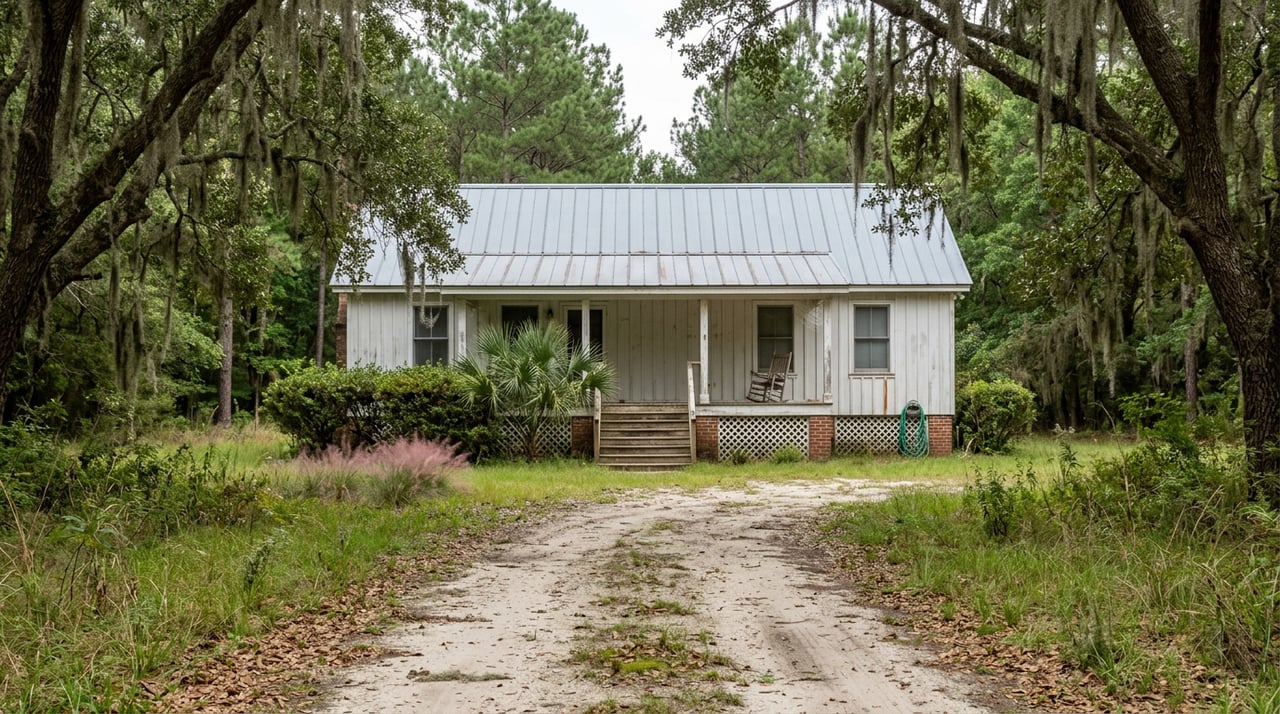
"Most people don't know that they're living on heirs' property," Luana Graves Sellars, founder of the Lowcountry Gullah Foundation, told a South Carolina news crew in July, describing what she sees happen to Sea Island families over and over. They find out only when a crisis forces the question: a death, storm damage, or a decision to finally sell.
On St. Helena Island, that crisis usually arrives at the exact moment a family decides to list. Land here has passed through generations of descendants without a will, without a recorded deed update, without anyone quite meaning for it to become a legal tangle. It becomes heirs' property: owned in common by every descendant of the original owner, whether they've ever set foot on it or not. This spring, South Carolina lawmakers passed a bill aimed squarely at that problem. Read the headlines and it sounds solved. It isn't. The new law fixes one specific, expensive moment inside a much longer process, the moment families reach right before they can even think about calling an agent.
What actually changed on May 15
On May 15, 2026, the governor signed the Heirs' Property Tax Relief Act, House Bill 4477, into law. Before this, transferring even a partial ownership share in real property normally counted as an "assessable transfer of interest," the trigger that lets a county reassess a property and often raise its tax bill. That rule made a certain kind of family decision expensive: an heir who wanted to consolidate shares with a cousin, in order to work toward a single clear owner, could set off a reassessment simply by doing the right thing.
The new law carves out an exception. When a qualified family member (a spouse, child, grandchild, sibling, niece, nephew, aunt, uncle, or cousin who already holds a legal claim to the property) transfers their interest to another qualified family member solely to clear the title, that transfer no longer counts as a taxable event. It applies to property tax years beginning after 2025.
Sellars pointed to why that penalty mattered so much in the first place. In one case she described, a family's annual property tax bill jumped from $440 to $2,200 after a reassessment following a death in the family, the kind of jump that makes relatives reluctant to touch the title at all, even when touching it is the only way toward a sale. Removing that specific penalty is real relief. It just isn't the whole problem.
One detail in the bill's own language is easy to miss: once a property's title is actually cleared, it stops being heirs' property and stops qualifying for this exclusion. The law is built for the transfers that happen on the way to a clear title, not for what comes after.
The step the law never touched
Clearing title itself still runs through the same legal process it always has: a quiet title action, filed in court, that identifies every living heir (sometimes scattered across several states), resolves competing claims, and results in a single deed the family, or a buyer, can actually rely on. Nothing about the May law shortens that process or reduces the number of court appearances it takes.
Beaufort County's own Treasurer's office is direct about the limits of what it can tell a family. The county does not formally track which parcels are heirs' property, though tax records sometimes carry an HRS or HEIRS notation as an informal flag. Paying the tax bill doesn't establish ownership either, a detail the county spells out because so many families assume it does. The office also notes a long-standing but legally unenforceable tradition at delinquent tax sales, where an heir announces they're bidding on heirs' property as an appeal to other bidders not to compete, and cautions against relying on that tradition to resolve a title.
A Beaufort-area law firm that specializes in this exact process, Heirs' Property Law Firm, LLC, publishes guidance that a family should reasonably expect clearing title to cost around 22 percent of the property's total value. That single number reframes the conversation more than any list price does. A family weighing whether to sell isn't just negotiating with a buyer. It's negotiating with the cost of becoming a seller in the first place.
Here's what that difference looks like in practical terms:
| Action | While still heirs' property | After a quiet title action clears |
|---|---|---|
| List with a real estate agent | Not possible | Possible |
| Get a mortgage or construction loan | Not possible for most lenders | Possible |
| Sell to a buyer outside the family | Not possible | Possible |
| Transfer a share to consolidate with another heir | No longer triggers a reassessment, as of May 2026 | Not applicable, title is already clear |
Why this matters more on St. Helena than almost anywhere else in the Lowcountry
Heirs' property touches coastal settlement communities across South Carolina. St. Helena Island carries an added layer that shapes what a cleared parcel can even become once it reaches the market. Since 1999, the island has operated under a Cultural Protection Overlay, a zoning tool adopted specifically to protect Gullah Geechee land and culture, and it bans golf courses, gated communities, and resorts anywhere within its boundaries, which cover the entire island including Pine Island and St. Helenaville. Beaufort County Council reaffirmed the ordinance's original intent with updates approved on May 8, 2023.
That restriction changes the buyer pool before a single offer comes in. A developer looking at cleared acreage on St. Helena Island can't fold it into a gated subdivision or a golf amenity package, the play that often maximizes price on comparable land elsewhere in Beaufort County. The clearest recent proof of how firmly that line holds: in 2023, a developer purchased the 502-acre Pine Island property for $18 million with plans for a golf resort, despite the overlay's explicit ban. Beaufort County Council voted 8-2 to deny the rezoning that would have carved the property out of the CPO, and the case moved into mediation with intervenors that included the Gullah/Geechee Sea Island Coalition and Penn Center. Whatever a family's land is worth once title clears, that value is set inside a zoning environment that has proven willing to say no to exactly the kind of buyer who'd pay the most for an exception.
Where to actually start, before you call an agent
- Check whether your family's parcel already carries an HRS or HEIRS notation on the Beaufort County tax records, a signal worth confirming rather than assuming.
- Reach out to Penn Center or the Center for Heirs Property Preservation, the two organizations Beaufort County's own Treasurer's office names as partners for families working toward a clear title.
- Talk with an attorney who handles heirs' property and quiet title actions specifically, since the new tax exclusion covers a narrow transfer between family members, not the eventual sale to an outside buyer.
- Plan for time as much as money. Locating every living heir can take longer than the legal filing itself, especially when descendants have moved off the island over the decades.
What this changes if you're planning to sell this year
The sequence hasn't changed: identify the heirs, retain counsel, complete a quiet title action, then list. What changed in May is the tax consequence of one step inside that sequence, the family-to-family transfer that consolidates shares on the way to a clear deed. That's meaningfully cheaper now. It doesn't compress the months a quiet title action can take, and it doesn't touch what the Cultural Protection Overlay allows a cleared parcel to become.
If your family is already mid-process, the practical order of operations is the same one it's always been. If you're only now learning your property carries an HRS notation, the smartest first call isn't to a real estate agent. It's to Penn Center, the Center for Heirs Property Preservation, or an attorney who does this work daily.
Does the new law mean my family can now sell heirs' property to an outside buyer without clearing title first?
No. The exclusion only applies to transfers between qualified family members made for the purpose of clearing title. Once title is cleared, the property is no longer heirs' property under the law and the exclusion no longer applies.
How do I find out if my St. Helena Island property is heirs' property?
There's no single registry that answers this. Beaufort County has said outright that it doesn't formally track heirs' property, though an HRS or HEIRS notation on tax records is worth investigating. A title search, or a conversation with the Treasurer's office or Penn Center, is the usual starting point.
Does clearing title cost the same for every property?
No. The process varies with how many heirs need to be located and whether any claim is contested. One Beaufort-area heirs' property law firm publishes that families should reasonably expect the process to run around 22 percent of the property's value, though every family's number will differ.
If your family is sitting on land that carries this kind of history on St. Helena Island, the sale conversation starts well before a listing photo gets taken. J.P. Signature Group has spent years working alongside Lowcountry families through exactly this process, and can help connect you with the local attorneys and organizations who handle the title side, so that when you are ready to sell, the property actually is. Contact Us.