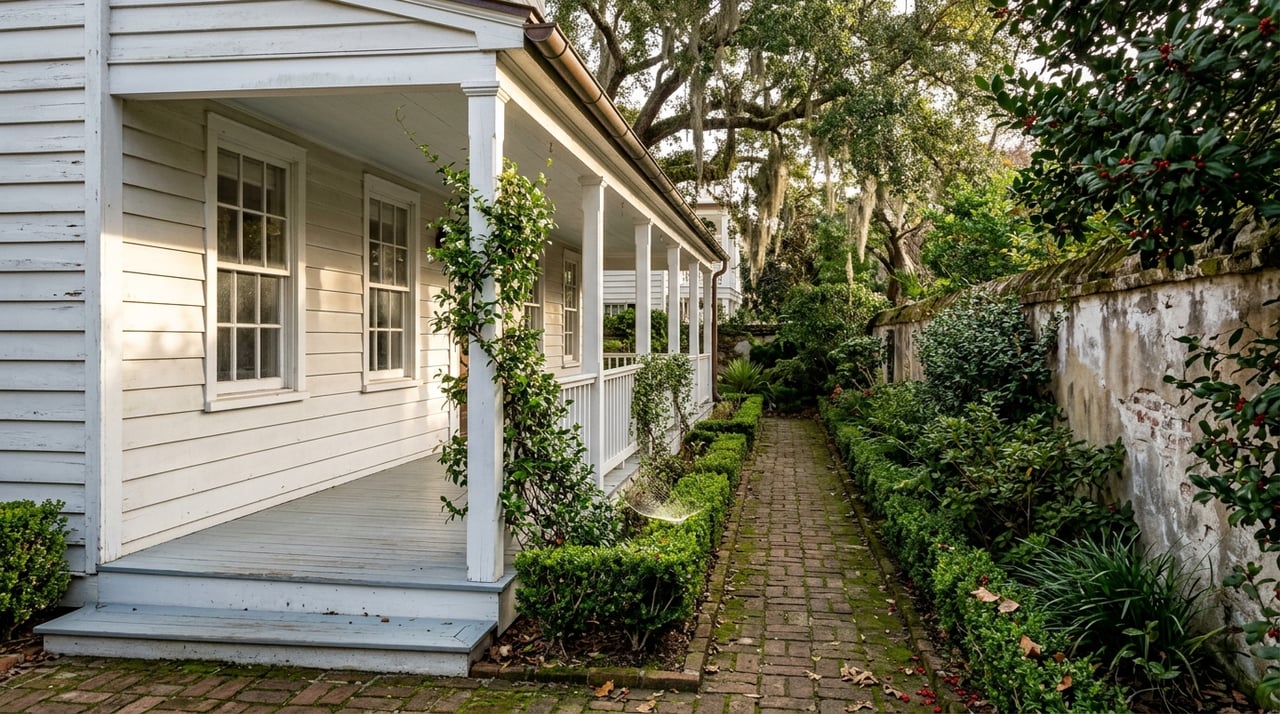
Across the city of Beaufort, homes sold in a median of 78 days over the three months ending May 2026, itself up from 61 days the year before. Inside the National Historic Landmark District, current listings are sitting even longer, a median of 81 days, at a median list price near $1.05 million. Most explanations for that gap point to price. A million-dollar home simply takes longer to sell than a $489,000 one, which was the city's overall median sale price in that same window.
That's true, but it's not the whole story. Talk to anyone who has tried to swap a roof, replace windows, or add a screened porch on a house inside the district before putting it on the market, and you'll hear about a different clock. It has nothing to do with buyer demand and everything to do with a board that meets once a month.
What Actually Slows a Historic District Sale
Any exterior work on a home within Beaufort's Historic District, additions, demolitions, new construction, renovations, or site work, requires a Certificate of Appropriateness from the city's Historic District Review Board. The board typically meets on the second Wednesday of each month at 2 p.m. Miss that Wednesday's submission deadline and the project waits another four weeks before it's even heard.
Projects don't move through in one pass, either. Depending on scope, an application can go through conceptual review, then preliminary review, then final review, each its own meeting cycle if the board asks for revisions. A seller who wants new windows approved and installed before listing isn't budgeting for a weekend project. They're budgeting for a season.
The board isn't idle. It evaluates roughly 175 projects a year across the district's preservation neighborhoods, according to a case study filed with South Carolina's Department of Archives and History. That volume is exactly why the calendar matters so much: a crowded agenda in any given month can push a hearing to the next one.
Here's how the numbers stack up side by side:
| Beaufort, citywide | Beaufort Historic District | |
|---|---|---|
| Median price | $488K–$489K (3 months ending May 2026) | $1.05M (current listings) |
| Median days on market | 78 days (May 2026), vs. 61 days a year earlier | 81 days (current listings) |
| Review required for exterior work | Standard building permit | Certificate of Appropriateness, HRB review |
The three-day gap between the district and the city overall looks small until you factor in that the district's homes are already the ones most likely to need window, roof, or porch work approved before a buyer's inspection contingency clock even starts.
The Math Behind a "Quick" Refresh
Say a seller wants to repaint the trim, replace a failing porch railing, and swap out an aging roof before listing. Paint color and roofing material both fall under the board's guidance in the city's Preservation Manual, last updated in December 2022 by the same Pennsylvania firm, John Milner Architects, that wrote the original 1979 report. Vinyl siding or windows, for instance, are generally not considered appropriate for historic structures, though the manual allows more flexibility for new construction inside the district.
If that seller applies for conceptual review in month one, gets asked for revised drawings, returns for preliminary review in month two, and receives final approval in month three, three months have passed before a contractor can legally start. Skip the process and do the work first, hoping to file paperwork after the fact, and the fee structure punishes that shortcut directly: post-facto applications are charged triple the normal fee. The first Historic Review Board application, by contrast, is free of charge for a first-time applicant.
For anything larger than a paint job, the fee scales with the project. An addition outside the smallest residential category runs a $500 base fee plus five cents per square foot. None of this is expensive by home-renovation standards. It's the lead time, not the cost, that catches sellers and buyers off guard.
Demolition or relocation is the far edge of this system, and it comes with its own requirement: a public hearing. That's a deliberate speed bump, built to make tearing down a contributing structure the hardest, slowest option on the table rather than the easiest one.
What the CL-100 Actually Finds on a Raised Foundation
South Carolina law requires a wood infestation report, commonly called a CL-100, before most home sales close. In Beaufort's Historic District, that report tends to find more to talk about than it would on a slab-built ranch across town.
Most historic Beaufort homes sit raised on brick or tabby piers with a crawl space underneath, a design that predates air conditioning and was built to catch river breezes. That same crawl space, combined with tidal moisture and salt air, is exactly where wood-destroying fungi and subterranean termites do their work. A CL-100 inspector checks for wood moisture content above 28 percent, evidence of prior treatment, and direct wood-to-soil contact points like trellises or fences touching the structure.
The city's own Preservation Manual tells owners to inspect crawl spaces frequently, clear scrap wood from around the foundation, and keep mulch and vegetation pulled back from the piers. That's not decorative advice. It's the same list a termite inspector runs through before signing off on a sale, and it's worth doing months before a buyer's inspection period rather than during it.
The Line Sellers Skip: Bailey Bill Math
Here's the part of this process that works in an owner's favor, and the part most sellers never bring up when they list.
South Carolina's property tax rate for owner-occupied primary residences is 4 percent of assessed value. Under the Bailey Bill, which the City of Beaufort and Beaufort County adopted in September 2014, a property owner who invests at least 75 percent of a historic building's assessed value into approved rehabilitation work can get that assessed value frozen at its pre-rehab level for ten years. To qualify, a property needs to either sit inside the Historic District and be at least 50 years old, or appear on the 1997 Beaufort County Above Ground Historic Sites Survey.
The application itself is inexpensive, $150 for a single-family home or duplex, filed alongside the standard HRB paperwork. For a buyer looking at a historic property that needs real work, that's a ten-year window where a substantial renovation doesn't translate into a substantial tax increase, something a fully renovated turnkey listing down the street can't offer at any price.
Sellers who've already done the qualifying rehab and locked in a frozen assessment have a genuine selling point buried in county tax records. It's worth pulling before writing the listing description, not after a buyer's agent finds it first.
Why the Process Is Also the Product
The same review board that slows down a roof replacement is the reason Beaufort's historic streets look the way they do, and that's not incidental to what buyers are paying for.
The Historic Beaufort Foundation, founded in 1965 after the John Mark Verdier House was saved from demolition, runs the Fall Festival of Houses and Gardens every October, opening private homes and gardens to ticketed tours. This year marks the festival's 52nd run, scheduled for October 16 through 18, with tickets going on sale in August. The Verdier House itself is marking fifty years as a museum this year, celebrated with a Music Salon Series that began in April, reviving the kind of parlor concerts once hosted there in the 1800s.
None of that happens without a century of deliberate, sometimes slow, decision-making about what gets to change and what doesn't. The board meeting a seller finds frustrating in June is the same mechanism protecting the streetscape a buyer will tour on foot in October. Both are true at once, and a listing strategy that accounts for the timeline usually outperforms one that fights it.
FAQ
Does every exterior project inside the district need board approval? Most do. The city's code lists additions, demolitions, new construction, renovations, and site work as activities requiring a Certificate of Appropriateness. Some smaller items may qualify for staff-level review rather than a full board hearing, but it's worth confirming before assuming a project is minor.
Can a seller start repairs while the house is already under contract? Nothing about the HRB process changes once a contract is signed. If a buyer's inspection turns up work that needs board approval first, that approval timeline runs independently of the closing date, and it's worth building into the contract's timeline rather than discovering it during due diligence.
Is the Bailey Bill only useful for sellers who've already renovated? No. A buyer purchasing a historic property with renovation plans can apply for Bailey Bill approval before starting work, which is often the better order of operations since the freeze locks in the pre-rehab assessed value rather than a post-purchase one.
If you're weighing a historic Beaufort property, whether you're the one selling it or the one about to take on the renovation, the timeline questions above are exactly where a local team earns its keep. J.P. Signature Group walks buyers and sellers through what the review board will actually ask for, what a CL-100 is likely to flag on a raised foundation, and whether a Bailey Bill application makes sense before or after you close. Contact Us to talk through your specific address and timeline.